Email me

Let's connect

Book a Call

logologo

  • Home
  • About us
  • Our Solutions
    • Coaching
    • Facilitating Change
    • Career Decisions & Transitions
    • Character
    • Mental Health & Wellbeing
    • Working Mothers
    • Mentoring & Supervision
  • Events & Training
  • Reflections & Insights
  • Get in Touch
  • Home
  • About us
  • Our Solutions
    • Coaching
    • Facilitating Change
    • Career Decisions & Transitions
    • Character
    • Mental Health & Wellbeing
    • Working Mothers
    • Mentoring & Supervision
  • Events & Training
  • Reflections & Insights
  • Get in Touch
  • Home
  • About us
  • Our Solutions
    • Coaching
    • Facilitating Change
    • Career Decisions & Transitions
    • Character
    • Mental Health & Wellbeing
    • Working Mothers
    • Mentoring & Supervision
  • Events & Training
  • Reflections & Insights
  • Get in Touch

A Layered View of Engagement: The ShareTree Model

June 8, 2026 by Bonita Lume Leadership 0 comments
CULTURE SURVEY SERIES: PART 5 of 6

What drew me to The ShareTree Character & Culture Model (www.sharetree.org) is not that it measures engagement. Many surveys do that.

What sets it apart for me is the combination of simplicity and depth. It presents results in a way that makes immediate sense for business, while the underlying model has a level of psychological rigour that captures the essence of culture and engagement in a way I have not seen any other framework do.

Culture Is Layered
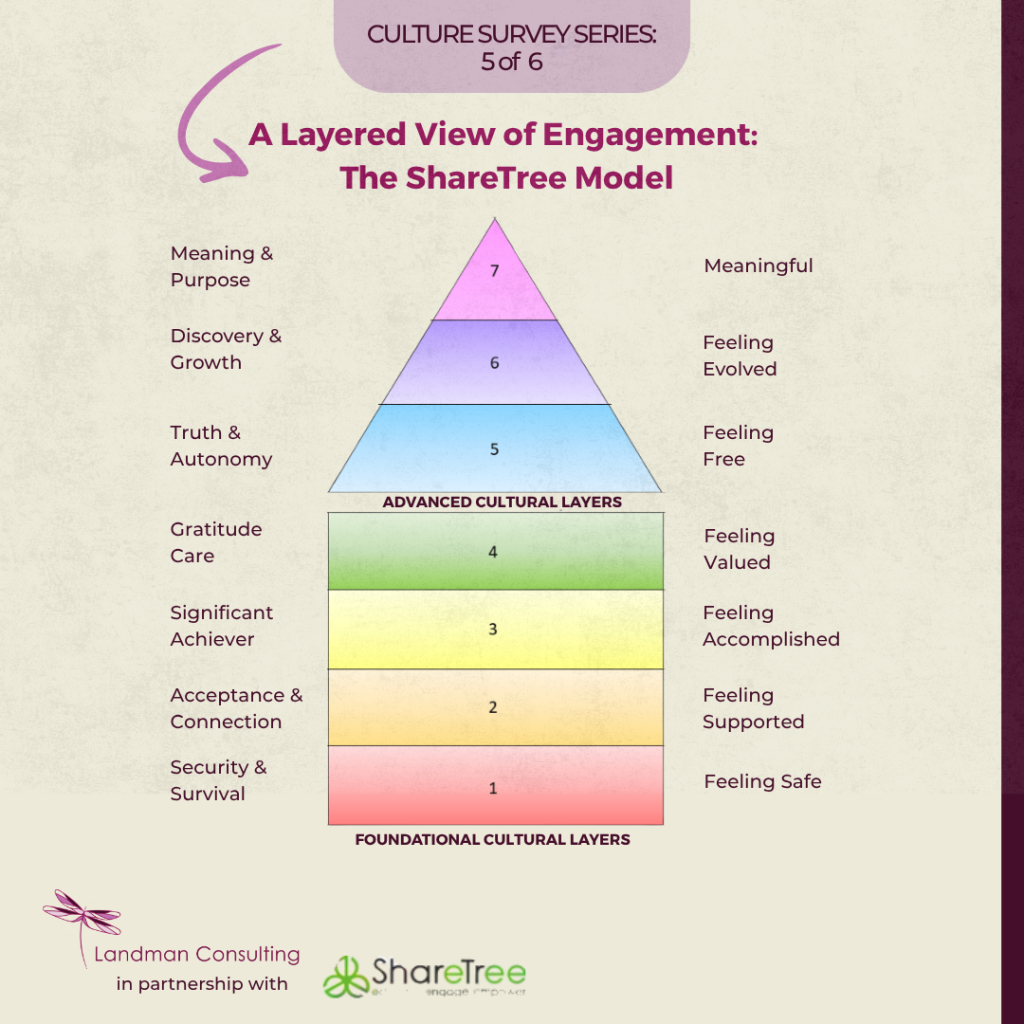
The ShareTree model recognises that engagement is not a mood, it is the result of layered human needs being met at work.

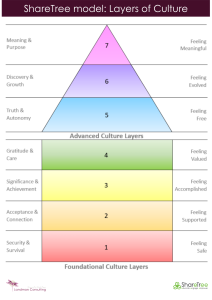
It measures workplace experience across seven progressive layers, moving from aspirational experience down to foundational needs:

  • Feeling Meaningful
  • Feeling Evolved
  • Feeling Free
  • Feeling Valued
  • Feeling Accomplished
  • Feeling Supported
  • Feeling Safe

Foundational needs (safety and support) enable higher-level drivers (autonomy, growth and purpose). If the foundation is unstable, higher engagement becomes fragile.

This layered structure prevents organisations from reacting only at the surface. It helps identify where pressure truly sits.

Culture Is Influenced
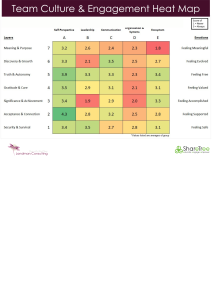
Beyond measuring experience, the model identifies five organisational levers that actively shape those layers:

A – Self perspective
C – Communication
E – Ecosystem
D – Organisational Systems
B – Leadership

These levers help move the conversation from “What are people experiencing?” to “What is influencing that experience  and where do we have the most leverage to shift it?”
 

The Heat Map: Clarity with Precision

The results are presented in a structured heat map, cross-referencing the seven layers with the five levers.

This visual output does something powerful.

It shows:

  • Where strengths live
  • Where foundational gaps exist
  • Which lever is influencing which layer
  • Whether the challenge is behavioural, structural or systemic


It replaces general statements like “engagement is low” with precise insight.
And precision changes the quality of action.

Engagement Is Not a Single Score
Most organisations measure engagement with a single question, often on a sliding scale (1 – 5 / 1-10).

The ShareTree model goes further.

Engagement is defined as the cumulative experience across all seven layers, and assessed across two core dimensions:
• Commitment / Satisfaction
• Advocacy / Energy

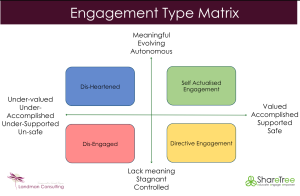
These dimensions form four engagement quadrants:

  • Highly Engaged (committed and advocating)
  • Engaged but Detached (committed but low energy)
  • Disengaged (low commitment and low advocacy)
  • Actively Disengaged (low commitment with negative influence)


This distinction matters.

Because not all “engaged” employees are energised ambassadors. And not all disengagement looks the same.

When you understand where people sit, action towards creating shifts becomes targeted.

In One Sentence
The ShareTree Model explains engagement as the result of meeting layered human needs at work, influenced by five organisational levers that leaders can intentionally strengthen.

It does not reduce culture to sentiment.
It makes it diagnosable.
And when culture becomes diagnosable, it becomes buildable.

Prev

Related Posts

From Helping to Empowering: Shifting from Pressure to Presence
December 10, 2025

As parents, we all want the best for our children. When it comes to their career...

Learn more
The Journey to Becoming a Leader Starts Within
October 20, 2025

Leadership is often framed as forward-moving, casting vision, managing outcomes,...

Learn more
From Guidance to Partnership: Supporting Our Young Adults as They Enter the World of Work
December 10, 2025

There comes a moment when the rhythm of parenting changes completely. One day,...

Learn more
Are Culture Surveys Still Worth It?
March 9, 2026

CULTURE SURVEY SERIES: PART 1 of 6 Culture and engagement surveys have become...

Learn more

© 2024 Landman Consulting. All Rights Reserved.