Three Common Mistakes That Quietly Undermine Culture Surveys

By now, we’ve established two things:
Culture surveys can be powerful, and
They can also quietly erode trust if nothing follows.
But there’s another layer to this conversation.
Over the years, I’ve noticed three common mistakes that consistently undermine culture surveys, even in organisations with good intent and capable leadership.
They’re not dramatic failures.
They’re subtle missteps.
And they matter.
1. We Treat Data as the Deliverable
The first mistake is operational, and it’s surprisingly common.
- We invest heavily in the mechanics of the survey
- We design the questions
- We drive participation rates
- We analyse the data
- We produce beautiful dashboards
- We present polished slides
- And then — the energy drops.
This is where momentum is lost:
- Themes aren’t translated into priorities (they remain a long list)
- Priorities aren’t translated into behavioural commitments (they stay as slogans)
- Leaders aren’t equipped to facilitate real conversations (results are simply presented)
- Ownership remains too centralised (often sitting with HR)
- Action plans remain broad and aspirational, rather than specific and accountable
When that translation step is missing, the survey becomes the event, not the starting point.
And culture does not shift because we gained insight.
It shifts because behaviour changes.
2. We Frame It as “Tell Us What’s Wrong and We’ll Fix It”
The second mistake is relational.
Many surveys are positioned, intentionally or not, as: “Tell us what’s wrong and we’ll fix it.”
It sounds inclusive. It feels responsible.
But it quietly creates passivity.
Employees criticise.
Leadership absorbs.
Everyone waits.
Healthy cultures are not built through outsourced responsibility.
They are co-created.
When engagement is positioned as something HR or senior leadership must “solve,” ownership weakens at every other level. Teams wait for direction instead of reflecting on their own contribution to the lived culture.
A survey should not be a complaint mechanism.
It should be an invitation to shared responsibility.
3. We Ask the Wrong Questions
The third mistake is structural and often invisible.
When survey items are ambiguous, double-barrelled, copied from generic templates or pulled from AI-generated question banks without contextual refinement, the data becomes unreliable.
Not because employees are dishonest, but because interpretation varies. And when interpretation varies, organisations respond to noise.
I have seen organisations invest heavily in interventions to fix “low engagement” scores, only to discover later that the issue was not the culture, it was how the question was interpreted.
If a survey item is unclear, the data is unclear.
And when the data is unclear, the action becomes misdirected.
Measurement is powerful.
But only when it is precise.
Culture surveys don’t fail because culture is unimportant.
They fail because the process lacks rigour in design, in positioning and in follow-through.
And discipline, not intent, is what ultimately determines whether insight becomes impact.
If You’re Not Prepared to Act, Stop Running Culture Surveys

Let me be direct.
If you are not prepared to do something meaningful with the results, stop running culture and engagement surveys.
Not because they don’t matter.
But because they matter too much.
In the previous post, I asked whether culture surveys are still worth it. The answer is yes — but only if we understand what we are stepping into when we launch one.
A survey is not just a measurement tool.
It is a signal.
When an organisation invites employees to share their experience, it communicates something powerful:
“We want to understand.”
And when employees respond, they are not simply selecting ratings on a scale.
They are investing something.
- Time
- Energy
- Honesty
- Often — hope.
“This is what it feels like to work here.”
“This is what matters.”
“This is where we are strong.”
“This is where we are struggling.”
Embedded in that participation is an expectation that the input will lead somewhere.
Not to perfection.
Not to immediate fixes.
But to movement.
When nothing visible follows, the impact is rarely dramatic.
It is subtle.
People adjust their expectations.
They participate more cautiously next time.
They give less of themselves.
And over time, the survey becomes something else entirely. Not a catalyst for progress, but an annual ritual that confirms nothing really shifts.
Running a culture survey without intentional, structured follow-through is like conducting a blood pressure check and deciding the results are inconvenient.
The data does not disappear.
The underlying issues do not disappear.
The risk simply compounds.
To be clear: acting does not mean responding to every comment or launching multiple new initiatives.
- It means translating insight into focused priorities.
- It means communicating what will — and will not — change.
- It means creating ownership at leadership, team and individual level.
- It means demonstrating that input matters.
Because culture is shaped not only by what we measure.
It is shaped by what we respond to.
If you are prepared to act: measure.
If you are not: pause until you are.
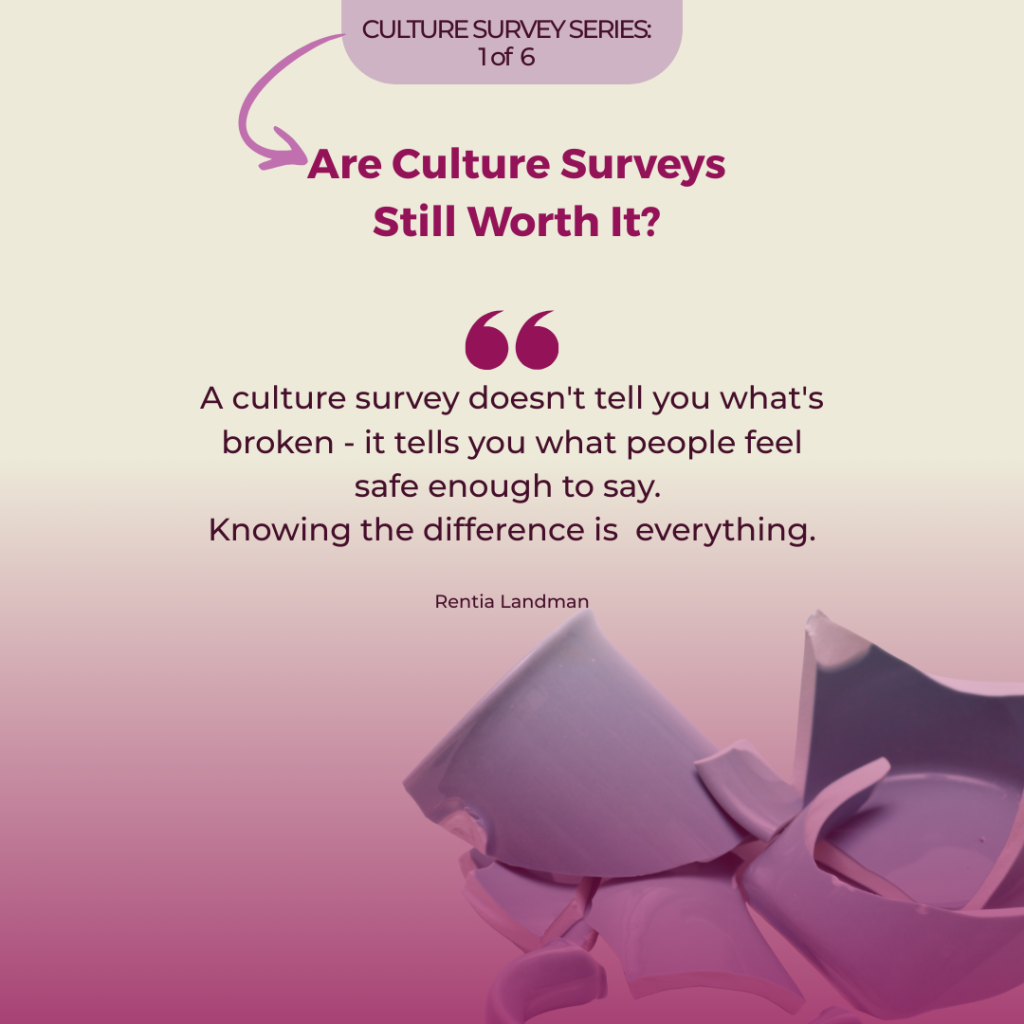
Are Culture Surveys Still Worth It?

Culture and engagement surveys have become almost standard practice in many organisations.
We run them annually.
We benchmark.
We compare.
We track trends.
But beneath that rhythm, a question quietly surfaces: Are they actually worth it?
When new clients reach out, the conversation often begins here. Not with scepticism about culture (most leaders deeply believe in its importance) but with uncertainty about impact.
“We’ve been measuring for years… and yet very little really seems to shift despite significant investment and effort in these surveys.”
Sometimes scores move marginally. Sometimes they remain flat. Occasionally they decline. And that’s when doubt creeps in.
Are we measuring the right things?
Are the results telling us something useful?
Or have surveys become an organisational ritual rather than a strategic lever?
They happen when surveys are designed with the end in mind.
When they are positioned carefully.
When they are followed through with discipline.
A survey, in itself, does not change culture.
It simply creates clarity.
And clarity is only valuable if it leads to action.
Over the next few weeks, I want to unpack what separates culture surveys that drive movement from those that quietly stall.
We’ll explore:
- Why surveys sometimes fail to translate into change
- The most common mistakes organisations make
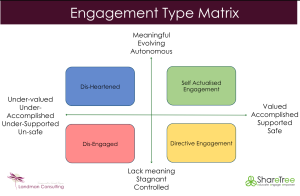
- Why engagement is more nuanced than a simple “engaged vs disengaged” line
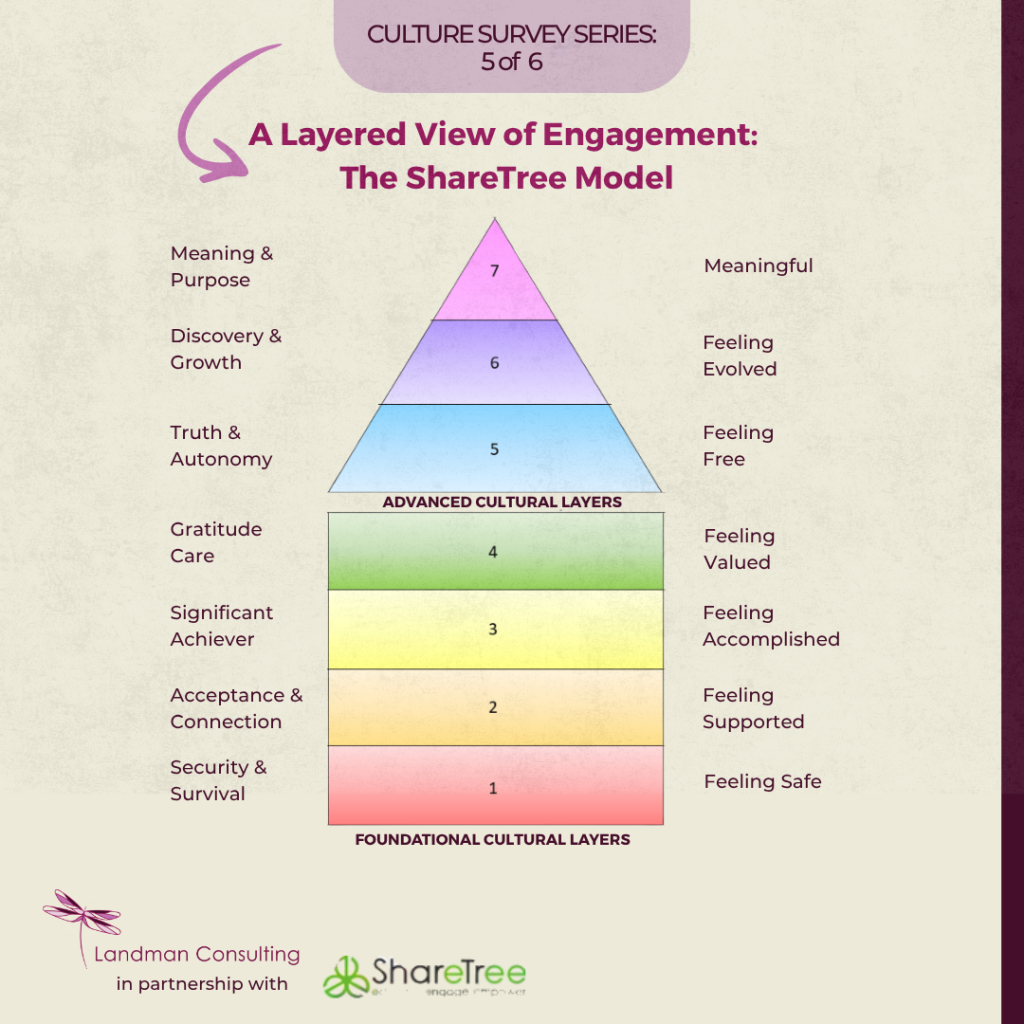
- How layered culture models sharpen insight
- And what disciplined follow-through actually requires
Culture surveys are not inherently ineffective.
But how we use them determines whether they become catalysts or just another data point.
From Guidance to Partnership: Supporting Our Young Adults as They Enter the World of Work

We watch them step into a world that will challenge, stretch, and shape them, a world we can no longer protect them from, but one we can still walk alongside them as they navigate.
In one of our Parent Empowerment workshops, we spoke about what this moment really asks of us as parents. Not new advice, but a new posture. Not more direction, but deeper trust.
The world our young adults are entering is fast-changing, unpredictable, and full of possibility. Careers are no longer linear; they unfold like a jungle gym, not a ladder. There will be detours, shifts, and moments of uncertainty.
But there will also be growth, discovery, and purpose, if they have the resilience and self-belief to navigate it.
And that’s where we, as parents, come in.
In these early years of work, our young adults are learning through experience, sometimes through success, often through struggle. They might wrestle with feedback, office politics, or their own expectations. Our instinct is to fix or advise. But what they often need most is not an answer, but a safe place to think out loud.
Listen with intent.
Notice what they’re learning, not just what they achieve.
Encourage effort, courage, and reflection, not perfection.
Connect with curiosity to their experience, not comparison to our own.
Empower by showing confidence in their ability and reflecting back the capability they already carry.
These simple acts create the foundation of partnership — a relationship where respect flows both ways.
Letting go, without stepping away
Letting go doesn’t mean disappearing. It means showing up differently. When we replace instruction with curiosity: “How did that feel?”, “What did you learn from it?” We signal trust in their capacity to grow.
They may stumble, change jobs, or question their choices. But these moments don’t mark failure; they mark becoming. Each experience, even the hard ones, adds to the story of who they are.
The truth is, our young adults won’t remember every piece of advice we gave them. But they’ll remember how we made them feel when life stretched them thin, calm, capable, and believed in.
Modelling what we hope they’ll carry
As parents, we are still teachers, not through instruction, but through example. When we respond to change with perspective, they learn adaptability. When we face uncertainty with grace, they learn composure. When we celebrate effort, not perfection, they learn resilience.
We no longer lead by being in front of them, but by walking alongside them, showing that growth never really ends; it just changes shape.
Because they don’t need us to be experts in their world. They need us to be steady in ours.
A new kind of togetherness
This stage of parenting invites a gentler rhythm, one built on trust, respect, and mutual learning. Our task now is to keep believing in who they are becoming, even when the path looks different from what we imagined.
To stand beside them, not above them.
To keep listening, noticing, encouraging, connecting, and empowering.
To remember that letting go was never about distance, it was about love growing spacious enough to let them lead.
The goal isn’t certainty; It’s confidence — theirs, and ours, in the unfolding of who they’re becoming.
If this message resonates, you can explore more reflections from our Parent Empowerment Series, where we walk with parents through each stage of this journey — from early choices to the first steps into the world of work.
Watch the discussion here
Post-School Pathways – One Goal, Many Roads

In one of our Parent Empowerment workshops, we explored this turning point, the transition from school to what lies beyond it. It’s a phase that feels both exciting and uncertain, filled with possibility yet pressed with deadlines. And once again, it invites us as parents to balance guidance with trust.
Exploring Possibility
By this stage, our children have learned to make decisions, but they are still learning to take ownership. They need encouragement to explore, to stretch, to ask, to imagine. They learn best through exposure, not pressure.
As parents, our role shifts from decision-maker to facilitator, the one who opens conversations, expands horizons, and reminds them that there is never only one right path. Because there really isn’t.
Instead, there is One Goal and many roads that lead to success.
Finding Direction
The question isn’t Which path is best?
It’s: Which path fits who you are right now, and what you still want to learn about yourself?
We can help by staying curious longer than we stay certain.
By replacing the question “What will you do?” with “What are you drawn to explore?”
By showing them that exploration itself is progress.
Practical support matters too. Attending open days, researching programs, speaking with professionals, applying to multiple institutions, these are all small steps that make the future feel tangible. Even when the outcome is unclear, each action builds confidence and readiness.
Building Readiness
Not every learner is ready to take the next big step immediately, and that’s okay. Sometimes the most meaningful growth comes through a purposeful pause. A year spent working, volunteering, or travelling can be a time of deep discovery and maturity. Used intentionally, a gap year isn’t a delay in progress; it’s a chance to build it from within.
This season also invites our own growth as parents. The instinct to manage or fix doesn’t disappear, but our children need us to believe they can lead their own next step. Letting them research, apply, and plan for themselves, even imperfectly, gives them something more lasting than results: self-belief.
Because growing up isn’t about knowing everything. It’s about learning to navigate when you don’t.
Our task isn’t to eliminate uncertainty, but to model calm within it, to show them that a meaningful life is not built in a straight line, but step by step, with reflection and courage.
Because the goal was never to find the one perfect path. It was to help them learn how to walk any path with confidence.
The goal isn’t certainty. It’s confidence, in choosing, in learning, and in becoming.
If this message resonates, you can explore more reflections from our Parent Empowerment Series, where we unpack each stage of your child’s journey, from early decision-making to stepping into the world of work.
Watch the discussion here
Grade 9 Subject Choices – A Test of Trust for Parents

The temptation to jump in is strong. We want to protect, to advise, to make sure they don’t close doors they might later wish were open. Yet in trying to keep them safe, we sometimes take away the very thing that will help them most: the chance to decide, to learn, and to trust themselves.
In one of our Parent Empowerment workshops, we explored how subject choices are less about subjects and more about self-knowledge. They invite young people to start discovering who they are, what excites them, and what they value. And they invite us, as parents, to practise something even harder: TRUST.
At this stage, the choices our children face are less about narrowing down options and more about beginning to name what feels like them, what sparks their curiosity, what gives them energy, and what kind of learner they are becoming.
Trust that curiosity will lead somewhere.
Trust that they don’t need certainty, they need confidence.
When we share our wisdom, it helps to offer it as an invitation rather than instruction. A small shift in language from: “In my day…” to “I have a thought I’d love to share — may I?”, keeps the conversation open and honours their growing independence.
Many families look to assessments for clarity, hoping they’ll make the choice easier. Assessments can be powerful when used as guides, not prescriptions. They offer pieces of a puzzle: aptitude, personality, motivation, abilities, but it’s only when we combine them with reflection and conversation that a full picture emerges. Used well, assessments become mirrors that invite reflection, not boxes that define potential.
Perhaps the hardest part is learning to hold our own anxiety gently. We fear that one wrong subject will derail the future, but in truth, very few choices are irreversible. Sometimes the best growth happens through redirection. What matters most is not that they get it “right” first time, but that they learn how to listen to themselves along the way.
This season is the first of many milestones where we’ll be asked to balance guidance with trust. The way we show up here, with calm curiosity rather than urgency, sets the tone for how our children will approach bigger decisions in years to come.
And when we replace pressure with presence, we make space for something far more powerful than perfection.
The goal isn’t certainty. It’s confidence.
Because each time we choose presence over pressure, we build not only their confidence, but our own capacity to trust the unfolding of who they are becoming.
If this message resonates, you can explore more insights from our Parent Empowerment Series, including conversations on helping your child navigate subject choices with confidence and self-trust.
Watch the discussion here
From Helping to Empowering: Shifting from Pressure to Presence

In our recent Parent Empowerment session, we explored this very shift. The temptation to jump in with answers is strong, but often what our children need most is not a solution, but a safe space. A place where they can think out loud, ask their questions, share their fears, and know they are heard without judgment.
Supporting in this way doesn’t mean stepping back or disengaging. It means showing up differently. Instead of offering strategies and ready-made plans, we offer our presence: listening, curiosity, and encouragement.
We ask questions like:
“What feels tricky about this decision for you?”
“Would you like me to just listen today, or would brainstorming together be helpful?”
This mindset shift, from directing to walking alongside, is at the heart of empowering our children. It transforms career conversations from pressure points into opportunities for growth, resilience, and self-discovery.
If this resonates with you, I invite you to watch the full recording of our first Parent Empowerment Session: From Helping to Empowering – A Parent’s Role in Their Child’s Career Journey. It’s filled with insights, stories, and practical advice from three of our Career Thinking partners – myself Rentia Landman, Pippa Rauch, and Jo Cloete.
Link to the full recording
The Gift of Authentic Acknowledgement

Authentic acknowledgement is different from thanks. It’s more personal, more deliberate.
Where a thank-you recognises action and achievement, authentic acknowledgement recognises the person behind them: “I see who you are, and the difference you make.”
It’s the act of naming the impact someone has had on your life, not just what they’ve achieved, but how they’ve made a difference. And the impact of that kind of genuine recognition can be profound.
Why authentic acknowledgement matters
Behavioural science tells us that humans are wired for recognition. It affirms belonging, meaning, and value, three of the strongest psychological needs we have.
And yet, we often wait for milestones or farewells to say the things that matter most. We deliver the heartfelt speeches at retirements and funerals, but not always at the everyday moments where they might have the most power.
For leaders and teams
For those leading teams or organisations, authentic acknowledgement has a ripple effect. When leaders pause to name people’s contributions, not just in metrics, but in meaning, it shifts culture.
It tells people, “You are more than your output; you are valued for your presence, your growth, your influence.”
End-of-year gatherings, team lunches, or even a closing email can become moments of genuine connection when they focus on who people are, not just what they’ve done.
Encourage teams to do the same, to acknowledge each other, peer to peer. It’s a practice that costs nothing and changes everything.
The end of the year is the perfect time
As one chapter closes, we naturally reflect on who’s walked beside us, colleagues, friends, mentors, teammates, family. Each has played a part in shaping the year that’s been.
What if, this December, we replaced (or at least complemented) our physical gifts with something that can’t be ordered or wrapped?
Words of authentic acknowledgement of meaning, growth, and value.
It could be as simple as a short note, a voice message, or a conversation that begins with:
- “This year, you made a difference in my world by…”
- “One thing I’ve appreciated about you is…”
- “Because of you, this year felt…”
Small gestures. Deep impact.
The deeper meaning of giving
The irony is that authentic acknowledgement isn’t only a gift to others, it’s also a gift to ourselves.
When we slow down to recognise the impact people have had on our lives, we reconnect to our own sense of gratitude, purpose, and perspective. It shifts the focus from what’s missing to what’s meaningful.
This kind of giving doesn’t clutter shelves; it fills hearts. It brings closure, strengthens connection, and reminds us of the humanity that underpins every role we play.
A reflection for this season
This season, may we not only exchange gifts, but also give voice to gratitude, and turn our thanks into something people can truly carry with them.
The Art of Ending Well

According to William Bridges, whose work on transitions has shaped decades of leadership and change thinking, every meaningful transition begins not with a new start, but with an ending. He reminds us that until we’ve acknowledged and honoured what is ending, the roles, routines, and identities that have defined us, we can’t fully step into what’s next.
In organisations, and in life, we’re far better at planning beginnings than navigating endings. We celebrate launches, not closures. Yet endings are the emotional architecture of growth. How we close one chapter shapes the quality of the next.
The psychology of closure
Behavioural science tells us that our brains crave completion. We seek the satisfaction of finishing, of crossing items off the list and resolving open loops. But emotional closure is different. It’s not about efficiency; it’s about meaning.
For leaders: creating space to end well
For leaders, endings are collective moments. How a leader helps a team close a year, a project, or even a relationship sets the emotional tone for what comes next.
Ending well begins with acknowledgment.
- Invite reflection before celebration. Ask: What did we learn? What will we take forward?
- Balance recognition of results with recognition of growth, skills developed, trust built, resilience tested.
- Make space for grief or frustration too. As Bridges noted, “Every transition begins with letting go.” People need permission to acknowledge what they’re leaving behind, the effort, identity, or sense of stability attached to a chapter now closing.
And then, celebrate.
Not the busyness, but the becoming. Celebrate not only what was achieved, but who people became through it.
Ending well within ourselves
On a personal level, ending well often means pausing to ask:
- What part of this year do I want to carry with me?
- What am I ready to release?
It might be a habit that no longer serves you, an expectation that’s too heavy, or even an inner narrative that limits what’s possible next. Letting go doesn’t mean forgetting, it means making peace with what’s complete.
When we skip this step, we risk dragging unfinished emotions into new beginnings, colouring what’s next with what’s unresolved.
A final reflection
As you and your teams prepare to step out of the year, resist the urge to rush past the ending. Take time to mark it.
Gather your people. Reflect on what you built together, what you overcame, and what you’ve learned. Speak gratitude, not just for outcomes, but for effort, courage, and presence.
Because when we end well, we begin again with lighter hearts and clearer minds.
Before you step into 2026, take time to honour what 2025 has been. Endings, celebrated well, are the quiet beginnings of everything that follows.
Wellbeing Isn’t Comfort, It’s Capacity

Psychologist Susan David, in her now-famous TED Talk on emotional agility, speaks about “the lie we’ve been sold — that discomfort is a sign of failure.” She offers a powerful alternative:
“Discomfort is the price of admission to a meaningful life.”
It’s such a liberating truth because it reminds us that the goal of wellbeing is not to remove discomfort, but to develop the capacity to live meaningfully through it.
Wellbeing isn’t about creating a life free of challenge. It’s about strengthening the inner container that allows us to stay centred when life doesn’t go according to plan, to hold steady in the midst of change, and to keep showing up with presence, even when the pace is relentless.
So often, we wait for circumstances to change before we prioritise wellbeing. We tell ourselves: “Once this project ends… once the kids are settled… once the holidays begin.”
But wellbeing doesn’t wait for conditions to be right; it’s what helps us navigate them.
Building capacity starts small, with noticing. Noticing when your breath has shortened, when your focus is fading, or when kindness feels harder to access.
These are not signs of failure; they’re invitations. Signals that your container needs care, not criticism.
The expanding edge
Think of that container, the one that holds your time, energy, and emotional presence.
It can stretch, but only so far before it needs reinforcement.
When we neglect rest, reflection, or connection, that container weakens.
When we nurture them, it expands.
Capacity grows through simple, deliberate choices:
- Saying no when we’ve reached our limit.
- Asking “What matters most right now?” instead of “How can I do it all?”
- Protecting the moments that bring perspective: a walk, a pause, a prayer, a laugh.
Every act of renewal adds strength to the container that holds our lives.
Capacity at work and at home
In the workplace, capacity is what enables sustainable performance. It’s what allows leaders to stay calm amidst complexity, teams to collaborate without burning out, and individuals to deliver consistently without losing their sense of purpose.
At home, capacity looks like having the emotional space to listen with patience, to laugh when plans change, or to admit when we need rest.
It’s the unseen thread that connects our professional resilience with our personal wellbeing, one feeding the other.
Beyond balance
We often speak about balance as the goal: the perfect alignment between work, family, rest, and play. But life rarely cooperates that neatly.
Instead of balance, wellbeing asks for rhythm. There will be seasons of stretch and seasons of recovery, times when we can give more and times when we must rest more.
The real skill lies not in achieving balance, but in recognising when to shift, to rebalance, re-prioritise, and refill.
That’s what true capacity gives us: the ability to move with life, rather than against it.
A reflection for this season
As we move through the final stretch of the year, the lists will keep growing, the pace may not slow, and the expectations won’t always shrink.
But our wellbeing is not found in clearing the lists, it’s found in how we hold them.
Perhaps discomfort isn’t something to resist this season, but something to lean into with curiosity, a quiet reminder that we are already living meaningfully, right here, amidst the stretch.
What might it look like for you to expand your capacity? Not by doing more, but by caring for the space within which everything else happens?